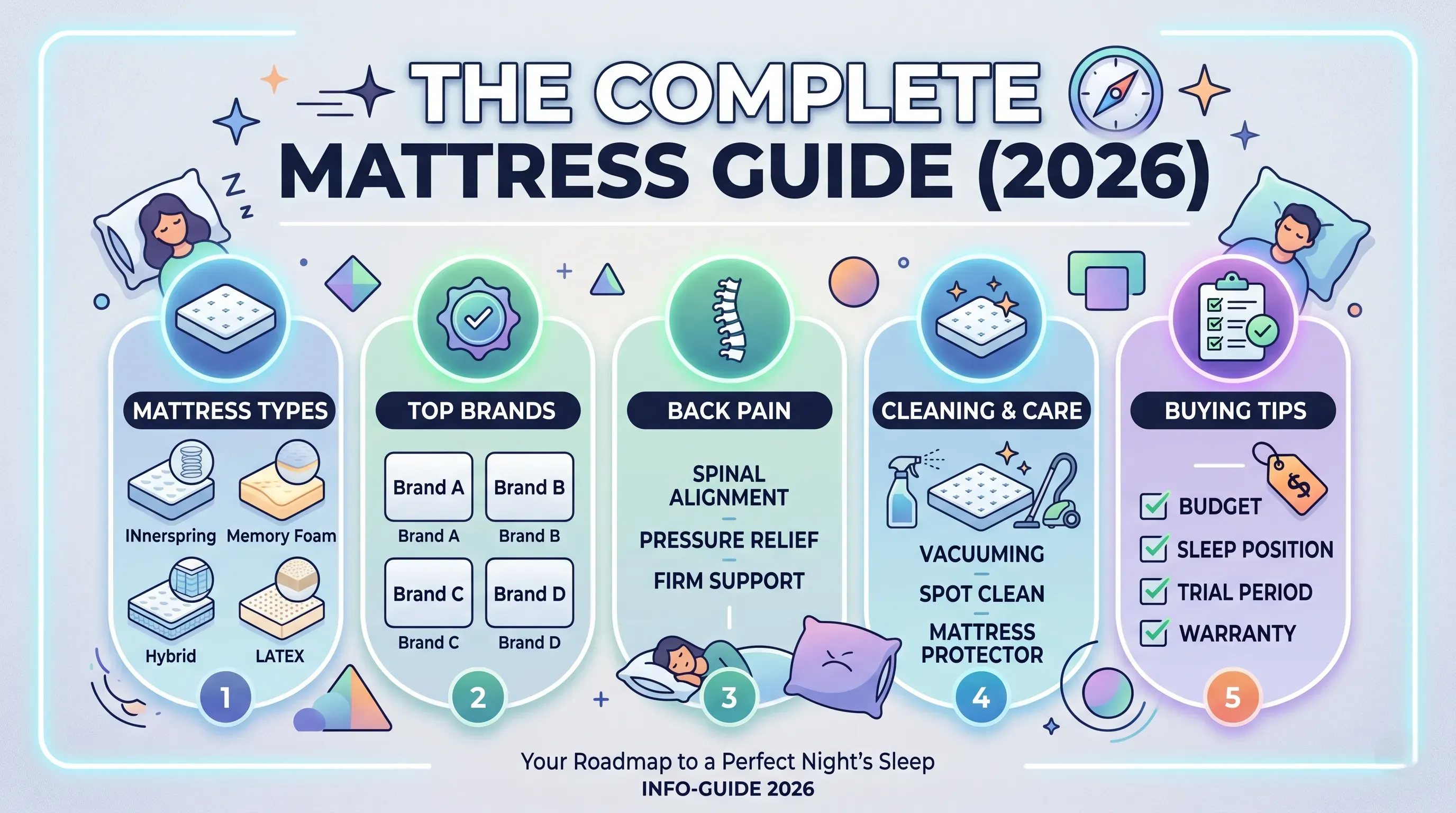
The Complete Mattress Guide: Types, Best Brands, Back Pain, Cleaning & Buying Tips (2026)
You spend roughly one-third of your life on your mattress. Yet most people spend more time researching a smartphone than the surface they sleep on every single night. The wrong mattress can cause back pain, disrupt sleep, trigger allergies, and quietly destroy your health over years. The right one can transform your sleep, your posture, and your daily energy.
This guide covers everything — what a mattress actually is, every major type explained, how to choose the right one for your body and budget, the best brands available in India in 2026, how to clean it properly, how to deal with bed bugs, and when it is finally time to replace it.
What Is a Mattress?
A mattress is a large, padded surface designed to support the human body during sleep. It sits on top of a bed frame or base and is engineered to distribute body weight evenly, maintain spinal alignment, and provide enough cushioning to prevent pressure points from forming at the hips, shoulders, and lower back.
The meaning of mattress goes far beyond a simple cushion. A well-designed mattress manages three competing demands simultaneously — support (keeping your spine neutral), comfort (cushioning pressure points), and temperature regulation (preventing heat buildup that disrupts sleep). Every mattress type makes different trade-offs between these three factors, which is why there is no single best mattress for every person.
The global mattress industry has evolved dramatically over the last two decades. Where once the only choice was a basic spring mattress or a cotton-stuffed gadda, buyers today can choose from memory foam, latex, pocket spring, orthopedic, coir, PU foam, and hybrid constructions — each with distinct properties and suited to different sleepers.
Understanding what a mattress is made of, how it works, and what your body specifically needs is the starting point for every good mattress decision.
Every Mattress Type Explained
Coil / Spring Mattress
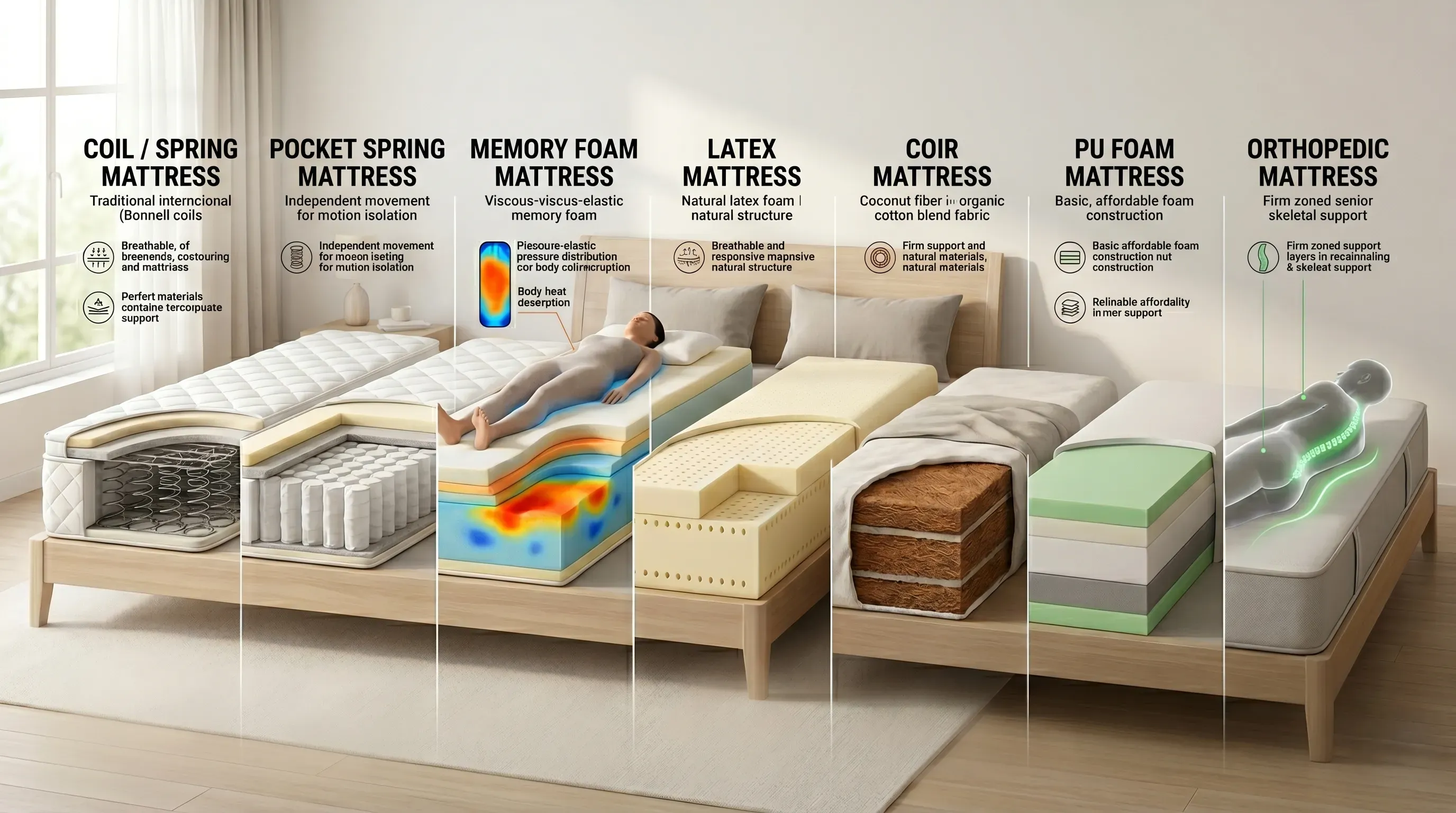
A coil mattress uses a network of metal springs as its support core. The springs compress under weight and push back, providing a bouncy, responsive feel. Traditional coil mattresses use interconnected springs (Bonnell coils) where pressure on one area affects the whole surface — meaning you feel your partner's movement. Spring mattresses are durable, affordable, and provide good airflow. However, they tend to sag over time and offer less precise pressure relief than foam.
Pocket Spring Mattress
A pocket spring mattress uses individually wrapped coils — each spring sits in its own fabric pocket and moves independently. This is a significant upgrade over traditional coil mattresses. Pocket spring mattresses provide better motion isolation (you do not feel your partner moving), more precise body contouring, and superior edge support. They also sleep cooler than most foam mattresses due to airflow between the springs.
Memory Foam Mattress
Memory foam was originally developed by NASA in the 1970s for aircraft seat cushioning. It is a viscoelastic foam that softens in response to heat and pressure, slowly conforming to the shape of your body and then recovering when pressure is removed. A memory foam mattress excels at pressure relief — it is particularly good for side sleepers and people with joint pain. The main drawback is heat retention. Memory foam traps body heat, making it uncomfortable for hot sleepers. Gel-infused and open-cell memory foam versions partially address this issue.
Latex Mattress
A latex mattress is made from either natural rubber sap (Dunlop or Talalay processed) or synthetic latex. Latex mattresses are responsive, bouncy, and naturally resistant to dust mites and mold — making them an excellent choice for people with allergies. Natural latex is also one of the most durable mattress materials available, often lasting 15–20 years. Latex sleeps cooler than memory foam and provides excellent pressure relief without the slow sinking sensation. The main drawback is weight — latex mattresses are significantly heavier than foam — and cost.
Coir Mattress
A coir mattress is made from coconut fiber (coir), which is compressed into a firm, natural base. Coir mattresses are extremely firm, naturally breathable, and very affordable. They are popular in India due to availability and price. The firmness makes them suitable for stomach sleepers and people who prefer a hard surface. However, coir mattresses offer limited contouring and pressure relief, and tend to deteriorate faster than foam or spring mattresses.
PU Foam Mattress
PU (polyurethane) foam mattress is the most common and affordable foam mattress type. It is a synthetic foam made from petroleum-based chemicals. PU foam is lightweight, inexpensive, and available in a wide range of firmness levels. Budget mattresses in India are typically PU foam. The downside is durability — PU foam compresses and loses its support faster than memory foam or latex, often within 3–5 years with regular use.
Orthopedic Mattress
An orthopedic mattress is specifically designed to support joints, the back, and the overall musculoskeletal system. The term "orthopedic" is not a regulated specification — any brand can use it — so it is important to look beyond the label. Genuine orthopedic mattresses tend to be firmer than average, designed to keep the spine in a neutral alignment, and often recommended for people with chronic back or joint pain. They typically use high-density foam, coil systems, or a combination.
Which Type of Mattress Is Best for You?
The best mattress type depends on your sleeping position, body weight, health conditions, and temperature preference.
Back sleepers need a medium-firm mattress that supports the natural curve of the lower back without letting the hips sink too deep. Pocket spring and medium-firm memory foam both work well.
Side sleepers put most pressure on their hips and shoulders. They need a softer, more contouring surface. Memory foam and soft latex are ideal for side sleepers.
Stomach sleepers risk lower back strain if the mattress is too soft and the hips sink forward. A firm mattress — coir, firm foam, or firm pocket spring — keeps the spine in a safer position.
Hot sleepers should avoid traditional memory foam and choose latex, pocket spring, or gel-infused foam for better temperature regulation.
Couples benefit most from pocket spring mattresses due to motion isolation. Memory foam also reduces motion transfer but sleeps hotter.
People with back pain are covered in detail in the next section.
Which Mattress Is Best for Back Pain?
Back pain is the single most common reason people research mattresses, and it is also the area with the most misinformation. The old advice of "firm mattress for back pain" has been thoroughly revised by modern research.
The best mattress for back pain is not the firmest one — it is the one that keeps your spine in neutral alignment while you sleep. A mattress that is too firm creates pressure points at the hips and shoulders, forcing the spine out of alignment. A mattress that is too soft lets the hips sink, creating a hammock effect that strains the lower back. The sweet spot is medium to medium-firm.
Best mattress types for back pain:
Memory foam — Excellent for back pain sufferers because it contours to the body and fills the gap between the waist and the mattress surface, supporting the lumbar curve. Medium-firm memory foam (typically around 5–6 out of 10 on firmness scale) is the most widely recommended by physiotherapists.
Latex — A latex mattress is good for back pain because it is responsive and supportive without the deep sinking of memory foam. It holds its shape better over time and provides consistent support. Natural latex is also hypoallergenic, which matters for people whose back pain is complicated by inflammation.
Orthopedic mattresses — A genuine high-density orthopedic mattress provides the targeted lumbar support that chronic back pain sufferers need. Look for orthopedic mattresses with a zoned support system — softer in the shoulder zone, firmer in the hip and lumbar zone.
Pocket spring — A good quality pocket spring mattress with a foam comfort layer is excellent for back pain because the independent coils adapt to different body zones, providing firmer support under heavier areas (hips) and softer support under lighter areas (waist and shoulders).
What to avoid for back pain: Very soft all-foam mattresses, old sagging spring mattresses, and very firm coir mattresses without any comfort layer.
Can a Mattress Cause Back Pain?
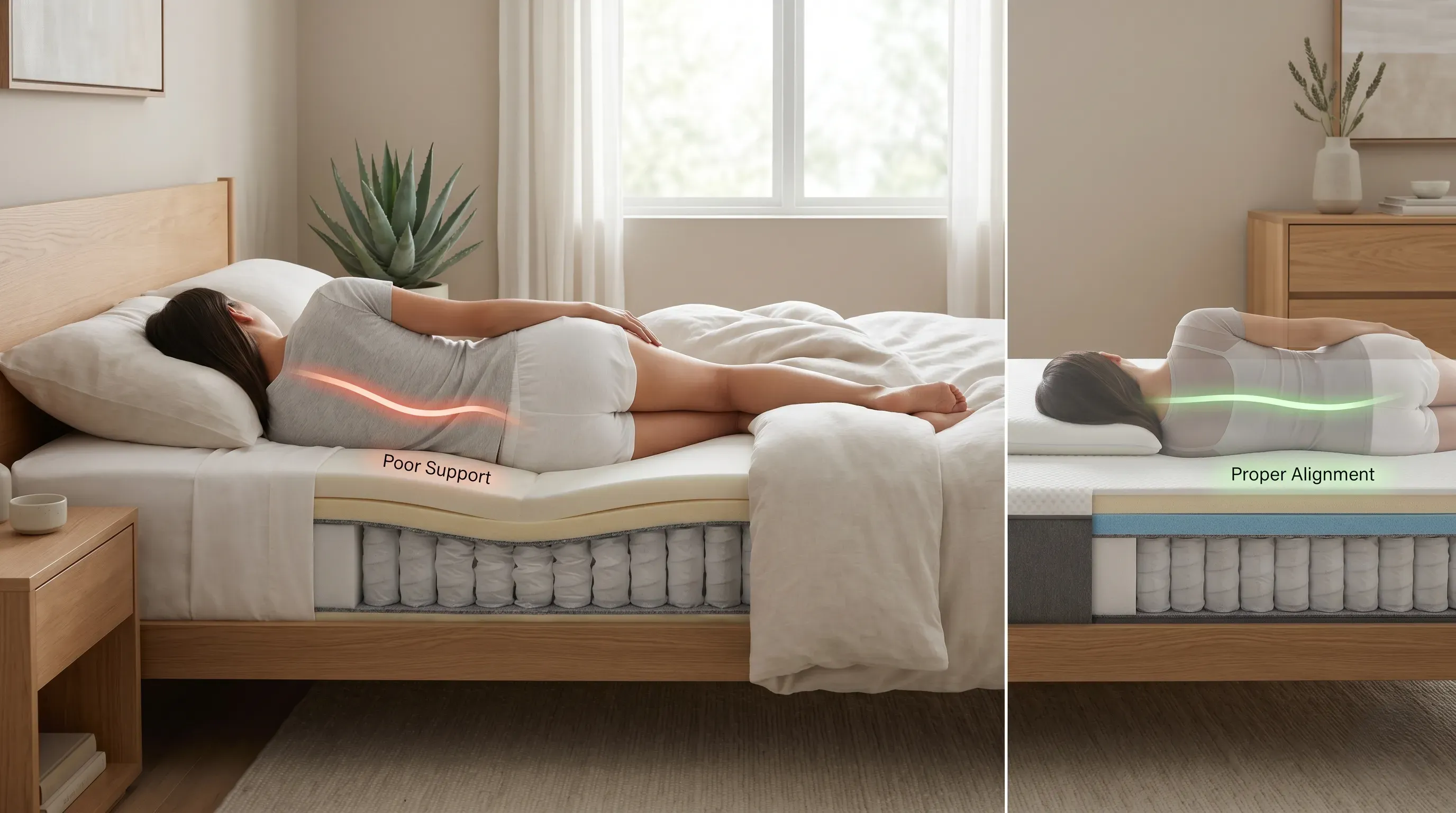
Yes — absolutely. A mattress can both cause and worsen back pain, and this is more common than most people realise.
A mattress causes back pain when it fails to maintain spinal alignment during sleep. If your mattress is too old and has developed sags or soft spots, your spine curves into those depressions every night for 7–8 hours. Over weeks and months this creates chronic muscular tension, ligament strain, and disc compression that manifests as morning back pain that eases throughout the day — a classic sign that your mattress is the culprit.
The clearest signs your mattress is causing your back pain are: you wake up stiff and sore but feel better after moving around for 30–60 minutes, you sleep better on other mattresses (hotel beds, a friend's guest room), you can see a visible sag or depression where you sleep, or your mattress is more than 7–8 years old.
Research published in The Lancet confirms that medium-firm mattresses significantly reduce chronic back pain compared to firm mattresses — debunking the long-held belief that harder is always better for the back.
If you wake up with back pain every morning, your mattress should be the first thing you investigate — before physiotherapy, before medication, before expensive diagnostic imaging.
How to Choose the Right Mattress
Choosing a mattress is one of the most important purchases you will make for your health. Here is a structured approach:
Step 1 — Identify your sleep position Back sleeper, side sleeper, stomach sleeper, or combination. This single factor narrows your options significantly (as covered in Section 3).
Step 2 — Assess your health needs Do you have back pain, joint pain, allergies, or a tendency to sleep hot? Each condition points toward specific mattress types. Back pain → medium-firm memory foam or latex. Allergies → natural latex or tightly woven pocket spring. Hot sleeper → latex or pocket spring.
Step 3 — Choose your firmness level Firmness is rated on a scale of 1–10. Most people sleep best between 4 (medium soft) and 7 (medium firm). Side sleepers generally prefer 3–5, back sleepers 5–7, and stomach sleepers 6–8.
Step 4 — Set your budget honestly A good mattress in India in 2026 starts at around ₹8,000–₹12,000 for a quality PU foam mattress, ₹15,000–₹30,000 for a good memory foam or pocket spring, and ₹40,000–₹1,00,000+ for premium latex or hybrid mattresses. Buying a mattress is a 7–10 year investment — calculate the cost per night, not the upfront price.
Step 5 — Check the trial period and warranty Reputable brands offer 100-night trials. Your body needs 3–4 weeks to fully adjust to a new mattress. A warranty of at least 7–10 years indicates manufacturer confidence in durability.
Step 6 — Measure your bed correctly Measure the inner dimensions of your bed frame, not the outer frame. Standard Indian mattress sizes are Single (72×36 inches), Double (72×48 inches), Queen (78×60 inches), and King (78×72 inches). Always measure before ordering.
Mattress Sizes in India — What You Need to Know
Getting the mattress size right is as important as getting the type right. Here are standard Indian mattress sizes:
|
Size |
Dimensions (inches) |
Dimensions (cm) |
Best For |
|
Single |
72 × 36 |
183 × 91 |
One adult or child |
|
Double |
72 × 48 |
183 × 122 |
Two adults (snug) |
|
Queen |
78 × 60 |
198 × 152 |
Two adults (comfortable) |
|
King |
78 × 72 |
198 × 183 |
Two adults (spacious) |
|
Super King |
78 × 84 |
198 × 213 |
Maximum space |
The biggest mattress size available in India is typically Super King at 78×84 inches, though custom sizes are available from premium brands.
When measuring your bed size for a mattress, always measure the interior sleeping surface of the bed frame — not the outer wooden frame dimensions. Add 1–2 cm of tolerance. For divan beds or box springs, measure the top surface where the mattress will rest.
Best Mattress Brands in India 2026
The Indian mattress market has transformed dramatically in the last five years with the entry of direct-to-consumer brands offering quality products at competitive prices.
Wakefit Wakefit is currently one of India's most popular mattress brands and for good reason. Their Orthopedic Memory Foam mattress offers a good balance of support and comfort at a mid-range price. Wakefit offers a 100-night trial and a 10-year warranty. For most Indians looking for a quality upgrade from a basic foam mattress, Wakefit is a reliable choice.
Sleepwell Sleepwell is one of India's oldest and most trusted mattress brands with over 50 years in the market. Their wide range covers everything from basic PU foam to premium latex and pocket spring options. Sleepwell mattresses are widely available offline, making them easy to test in person before buying — an advantage that online-only brands cannot offer.
Flo Mattress Flo is a newer direct-to-consumer brand that has gained strong reviews for its ErgoSleep foam technology and cooling covers. Their mattresses come with a 100-night trial and competitive pricing. Flo is particularly well-regarded for combination sleepers who change positions frequently during the night.
Emma Mattress Emma is a European brand with strong presence in India. Emma mattresses use a patented multi-layer foam system and consistently receive high ratings for back pain relief and motion isolation. Emma is a premium option but the quality justifies the price for most buyers.
Duroflex Duroflex is one of India's largest mattress manufacturers with a strong offline presence. Their Duropedic range is widely recommended by orthopedic specialists. Good option for buyers who want the reassurance of a brand with a large physical service network.
Kurl-on Kurl-on is a household name in India and offers one of the widest product ranges from budget coir mattresses to premium latex and spring options. Widely available across India and trusted for durability.
Which Mattress Is Best for Health?
When people ask which mattress is best for health, they are typically asking about three things: spinal health, respiratory health, and sleep quality.
For spinal health — A medium-firm latex or memory foam mattress that maintains neutral spinal alignment regardless of sleep position is the healthiest choice. The spine should form a straight line from neck to tailbone when viewed from behind, and maintain its natural S-curve when viewed from the side.
For respiratory health and allergies — Natural latex is the healthiest mattress material for allergy sufferers. It is naturally resistant to dust mites, mold, and mildew — the three primary mattress-based allergens. Memory foam is also relatively resistant to dust mites due to its dense structure. Coir and spring mattresses accumulate dust and allergens more readily and require more frequent cleaning.
For sleep quality — The healthiest mattress for sleep quality is one that keeps you cool, reduces pressure points, and minimises partner disturbance. Pocket spring with a comfort layer or natural latex rates highest on all three measures.
For children — Firm to medium-firm mattresses are recommended for children as their developing spines benefit from consistent support. Avoid very soft memory foam for young children.
The mattress that is best for your health is ultimately the one that consistently gives you 7–9 hours of uninterrupted, comfortable sleep with no pain on waking. That is the functional definition of a healthy mattress.
How to Clean a Mattress at Home
A mattress should be cleaned at least twice a year, and spot-cleaned whenever spills or accidents occur. Most people never clean their mattress — which means they are sleeping on years of accumulated dead skin cells, dust mites, sweat, and bacteria.
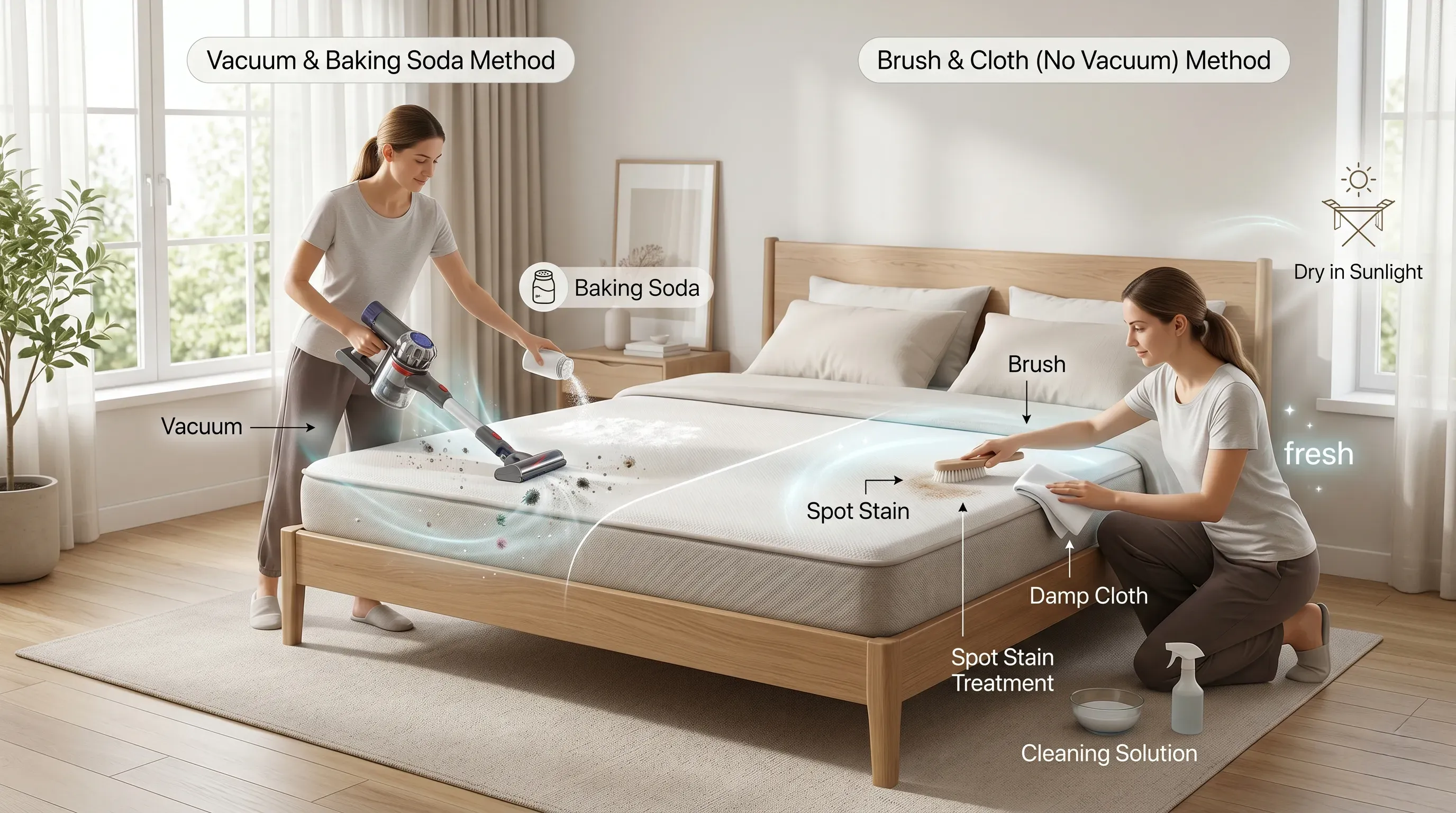
Here is how to clean a mattress at home properly:
Method 1 — With a Vacuum (Standard Clean)
- Strip all bedding and wash at 60°C to kill dust mites.
- Vacuum the entire mattress surface using the upholstery attachment. Pay special attention to seams and edges where dust mites concentrate.
- Sprinkle a generous, even layer of baking soda over the entire surface.
- Let the baking soda sit for at least 2–4 hours (overnight is better). Baking soda absorbs moisture and neutralises odours.
- Vacuum all the baking soda off thoroughly.
- Flip or rotate the mattress, and repeat on the other side.
- Allow the mattress to air out in a ventilated room or in sunlight for 1–2 hours before making the bed.
Method 2 — How to Clean a Mattress at Home Without a Vacuum
If you do not have a vacuum, the process is similar but requires more manual work:
- Take the mattress outside or to a well-ventilated space.
- Beat the mattress surface firmly with a clean broom or paddle to dislodge dust and debris.
- Apply baking soda generously and leave for 3–4 hours.
- Brush the baking soda off with a stiff dry brush.
- Wipe the entire surface with a clean cloth lightly dampened with a diluted white vinegar solution (1 part vinegar to 2 parts water). This sanitises the surface.
- Allow to dry completely in sunlight before returning to the bed frame.
How to Remove Stains from a Mattress
Different stains require different approaches. Always act quickly — fresh stains are dramatically easier to remove than set-in ones. Never saturate the mattress with liquid, as moisture trapped inside promotes mold growth.
How to Remove Urine Stains and Smell from a Mattress
Urine stains are the most common mattress stain, particularly in households with young children or pets.
- Blot up as much fresh urine as possible immediately using dry towels. Press firmly — do not rub.
- Mix 240ml hydrogen peroxide (3%), 3 tablespoons baking soda, and a few drops of dish soap in a spray bottle.
- Spray the stained area generously and let it sit for 15–20 minutes.
- Blot dry with a clean cloth.
- Sprinkle dry baking soda over the area and leave for several hours to absorb residual moisture and odour.
- Vacuum or brush off the baking soda once completely dry.
For removing urine smell from a mattress where the stain has already dried, white vinegar is highly effective. Spray undiluted white vinegar, let it sit for 10 minutes, blot dry, and follow with baking soda.
How to Remove Blood Stains from a Mattress
Always use cold water for blood — hot water sets the stain permanently.
- Mix 2 tablespoons of salt with 1 tablespoon of dish soap and enough cold water to make a paste.
- Apply to the stain and let sit for 30 minutes.
- Blot away with a cold damp cloth.
- For stubborn dried blood stains, hydrogen peroxide applied directly and left for 5 minutes before blotting can lift the stain significantly. Test on a hidden area first as hydrogen peroxide can lighten some fabrics.
How to Remove Period Stains from a Mattress
Period stains are blood-based and follow the same rules — always cold water, never hot. The salt and dish soap paste method above works well. For set-in period stains, an enzyme-based cleaner (available at most supermarkets) is highly effective as enzymes break down biological matter.
How to Remove General Stains from a Mattress
For food, drink, or unknown stains:
- Mix 1 tablespoon of dish soap with 2 tablespoons of cold water.
- Apply with a clean cloth using a circular motion from the outside of the stain inward to prevent spreading.
- Blot dry, do not rub.
- Rinse lightly with cold water and blot dry again.
- Follow with baking soda to absorb any remaining moisture.
How to Get Rid of Bed Bugs in a Mattress
Bed bugs are one of the most stressful mattress problems to deal with. They are small, reddish-brown insects that feed on human blood, primarily at night. They do not transmit disease but their bites cause intense itching, and an infestation grows quickly if not addressed.
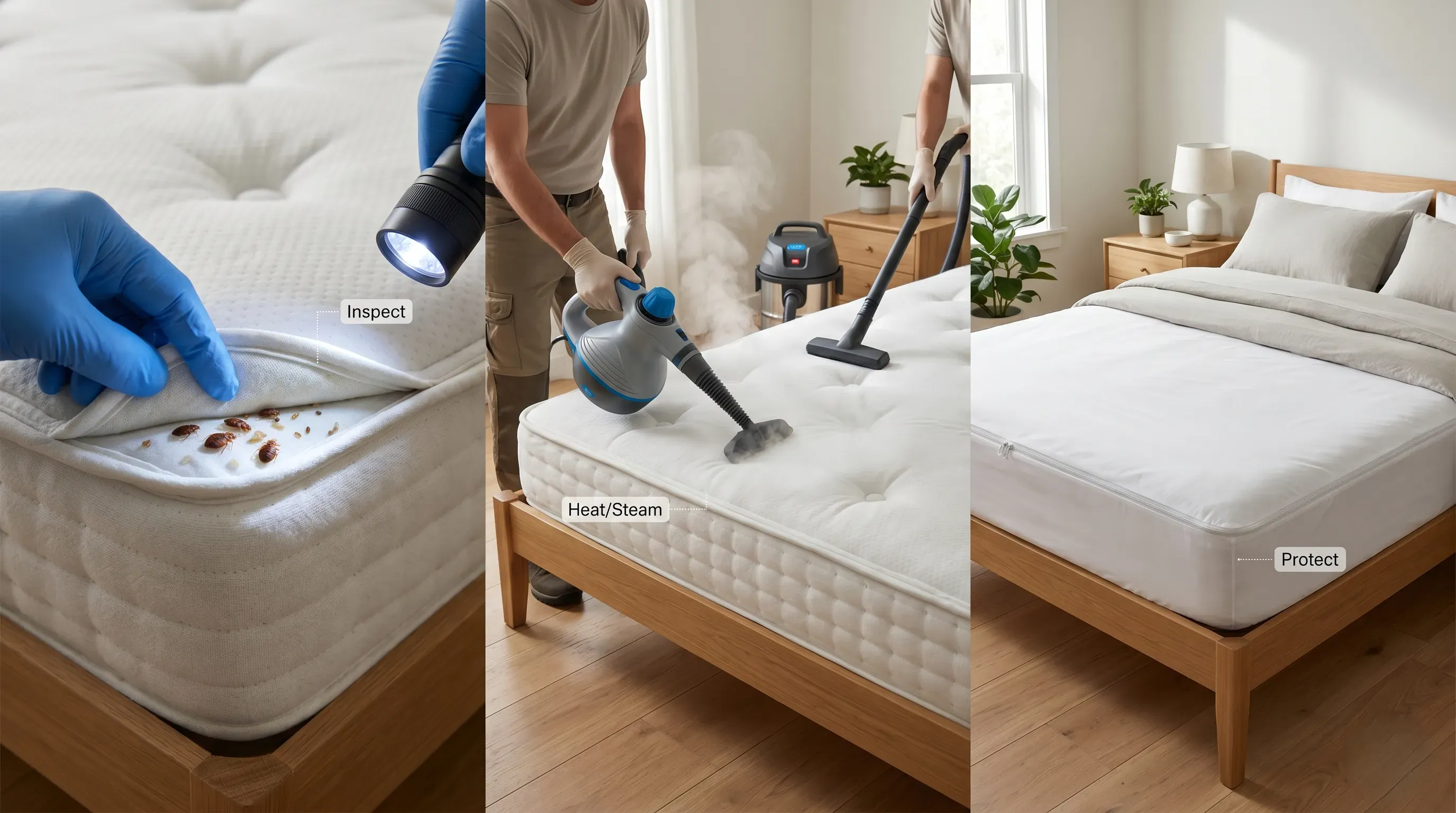
How to Check Your Mattress for Bed Bugs
Before treatment, confirm the infestation. Bed bugs are roughly the size of an apple seed. Signs to look for include: small reddish-brown bugs in mattress seams and corners, tiny dark spots (excrement) on the mattress surface, blood stains on sheets, a musty sweet odour in the room, and itchy red bite marks on your skin arranged in lines or clusters.
Use a flashlight to inspect all mattress seams, the box spring, the bed frame joints, and even the walls near the bed.
How to Remove Bed Bugs from a Mattress
- Strip and wash all bedding immediately at 60°C or higher. Place washed items in a dryer on high heat for 30 minutes. Heat kills bed bugs at all life stages.
- Vacuum the entire mattress thoroughly — all surfaces, seams, and edges. Immediately seal the vacuum bag in a plastic bag and dispose of it outside.
- Steam treatment — A garment steamer or professional steam cleaner applied slowly to all mattress surfaces kills bed bugs on contact. Steam at temperatures above 48°C kills bed bugs instantly. This is the most effective non-chemical method.
- Encase the mattress in a bed bug-proof mattress encasement immediately after treatment. This traps any remaining bugs inside where they will die without a food source over 12–18 months, and prevents new bugs from entering.
- Treat the bed frame and surrounding area — Bed bugs do not live only on the mattress. Apply a residual insecticide spray approved for bed bugs to the bed frame, headboard, and baseboards.
- Repeat treatment after 2 weeks to catch any eggs that hatched after the first treatment.
For severe infestations, professional pest control is strongly recommended. DIY treatment may reduce populations but professional heat treatment (raising room temperature to 50°C+ for several hours) is the most reliable method for complete elimination.
Mattress Accessories — Toppers, Protectors and Covers
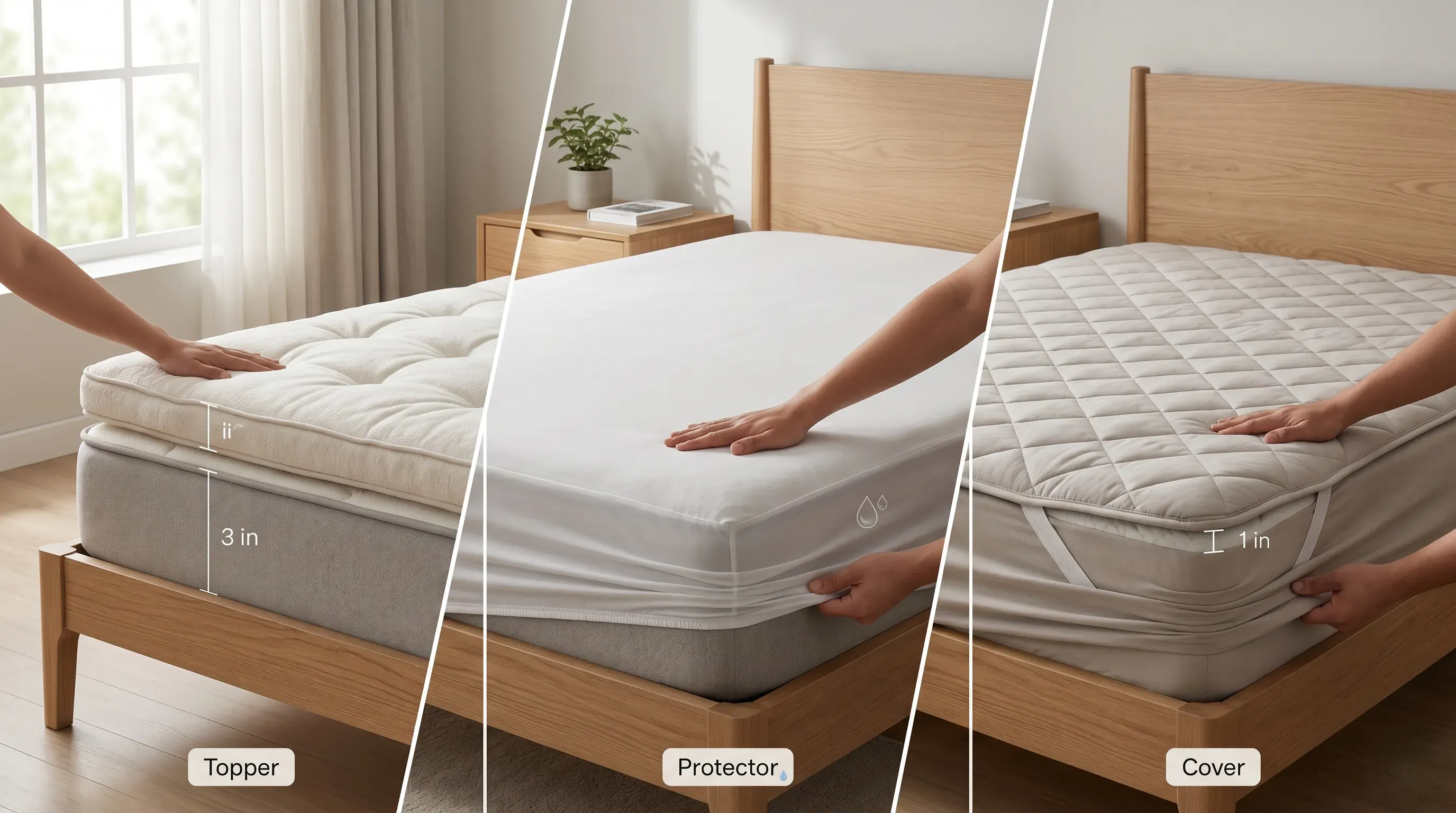
What Is a Mattress Topper?
A mattress topper is a removable layer of cushioning that sits on top of your mattress. It is typically 5–10 cm thick and made from memory foam, latex, wool, down, or gel foam. A mattress topper can make a firm mattress softer, add a comfort layer to an ageing mattress, or provide extra pressure relief for people with joint pain.
A mattress topper is not a substitute for a good mattress — it cannot fix a sagging or structurally compromised mattress — but it is an excellent way to fine-tune the feel of an otherwise good mattress.
What Is a Mattress Protector?
A mattress protector is a thin, fitted cover that goes over the mattress (and under the fitted sheet) to protect it from spills, stains, allergens, and dust mites. A good mattress protector is waterproof on the underside and breathable on top. It extends the life of your mattress significantly and is particularly valuable in households with children, pets, or allergy sufferers.
Making your own mattress protector is possible — a waterproof fabric such as PUL (Polyurethane Laminate) can be sewn into a fitted cover — but commercially available protectors are inexpensive and highly functional.
What Is a Mattress Cover?
A mattress cover is similar to a protector but typically refers to a quilted or padded cover that adds a small amount of extra cushioning in addition to protection. Some covers fully encase the mattress (useful for bed bug protection) while others are fitted over the top surface only.
How Often Should You Change Your Mattress?
The general recommendation is to replace your mattress every 7–10 years, but this is not a hard rule. The actual lifespan depends on mattress type, usage, and care.
Typical mattress lifespans:
|
Mattress Type |
Average Lifespan |
|
PU Foam |
3–5 years |
|
Memory Foam |
7–10 years |
|
Latex (Natural) |
12–20 years |
|
Pocket Spring |
8–12 years |
|
Coir |
4–6 years |
|
Innerspring / Coil |
6–8 years |
Signs it is time to change your mattress regardless of age: visible sagging or body impressions deeper than 3 cm, waking up with back or joint pain that eases during the day, significantly better sleep elsewhere, visible springs poking through, persistent odour that cleaning does not resolve, or a history of bed bug infestation that was not fully resolved.
Natural latex mattresses offer the best value over time despite their high upfront cost. A ₹60,000 latex mattress lasting 18 years costs roughly ₹3,300 per year — far less than replacing a ₹12,000 PU foam mattress every 4 years.
How to Dispose of an Old Mattress

Mattresses are bulky, difficult to dispose of responsibly, and most people have no idea what to do with them. Here are your best options:
Donate it — If the mattress is still in usable condition (no sagging, no infestation, no major stains), many NGOs, shelters, and charitable organisations in India will collect used mattresses. Contact your local municipal office or NGO network.
Sell it — Platforms like OLX and Facebook Marketplace allow you to sell used mattresses. Even an old mattress in reasonable condition can fetch ₹500–₹2,000.
Municipal collection — Most Indian municipal corporations have bulk waste collection services. Contact your local municipal corporation to schedule a pickup.
Manufacturer take-back — Several mattress brands including Wakefit and Duroflex have begun mattress recycling or exchange programs. When purchasing a new mattress, ask whether the brand will collect your old one.
Repurpose it — Old mattress foam can be cut into cushions, pet beds, or moving protection pads. Springs from old coil mattresses can be recycled as metal scrap.
How to pack a mattress for moving — Use a purpose-made mattress bag (available online and at moving supply stores) to protect the mattress from dirt and moisture during transport. Do not fold or bend a spring or latex mattress — this can permanently damage the internal structure. Memory foam mattresses can be rolled or compressed for short-term transport only.
Conclusion
Your mattress is not just a piece of furniture — it is the foundation of your physical recovery every single night. The wrong mattress silently accumulates damage: chronic back pain, disrupted sleep, worsening allergies, and fatigue that no amount of coffee can fix. The right one pays dividends in energy, health, and wellbeing every single morning.
Here is what to take away from this guide. If you have back pain, move to a medium-firm memory foam or latex mattress and stop assuming firmness equals support. If you have never cleaned your mattress, do it this weekend — baking soda and white vinegar cost almost nothing and will meaningfully improve the hygiene of the surface you breathe against for 8 hours every night. If your mattress is older than 8 years and you wake up stiff every morning, stop looking for other explanations.
India in 2026 has better mattress options at every price point than ever before. The 100-night trials offered by most leading brands remove all the risk from buying. There is no reason to spend another year sleeping badly on a mattress that is working against you.
Invest in your sleep. Everything else in your life improves when you do.